Categories
Battery News China Deals Electric eMobility eV Fund Raising Solid-state Battery Talent New Energy

Solid-state battery startup Talent New Energy closes new funding, has over 10 GWh of capacity planned

Talent's second phase of a 2 GWh/year plant in Chongqing is expected to be completed by the end of 2023, and a 10 GWh/year industrial park project in Anhui is under construction.

The post Solid-state battery startup Talent New Energy closes new funding, has over 10 GWh of capacity planned appeared first on CnEVPost.

For more articles, please visit CnEVPost.

Categories
Battery News China Earnings Earnings Preview Electric eMobility eV Gotion

Gotion expects H1 profit to rise as much as 209.69% to $28 million

Gotion's earnings preview implies it will post a net profit of RMB 7,439 to RMB 124.4 million in the second quarter, a year-on-year increase of 129.46 percent to 283.68 percent.

The post Gotion expects H1 profit to rise as much as 209.69% to $28 million appeared first on CnEVPost.

For more articles, please visit CnEVPost.

Categories
Battery News China Earnings Earnings Preview Electric eMobility eV Gotion

Gotion expects H1 profit to rise as much as 209.69% to $28 million

Gotion's earnings preview implies it will post a net profit of RMB 7,439 to RMB 124.4 million in the second quarter, a year-on-year increase of 129.46 percent to 283.68 percent.

The post Gotion expects H1 profit to rise as much as 209.69% to $28 million appeared first on CnEVPost.

For more articles, please visit CnEVPost.

Categories
Battery News China Electric eMobility eV Insights Solid-state Battery

EVs with all-solid-state batteries expected to be in mass production by 2030, doubling range from today, TrendForce says

By then, the energy density of lithium batteries could reach 500 Wh/kg, providing EVs with two to three times the range of liquid lithium batteries and tying the range of fuel vehicles, TrendForce said.

The post EVs with all-solid-state batteries expected to be in mass production by 2030, doubling range from today, TrendForce says appeared first on CnEVPost.

For more articles, please visit CnEVPost.

Categories
Battery Data Battery News BYD CABIA CALB CATL China Electric eMobility eV Gotion High-Tech LFP Batteries Monthly Data Ternary Batteries

China Jun EV battery installations: CATL share expands to 45.13%, BYD falls to 27.38%

BYD topped the LFP battery market with a 39.61 percent share, but lower than its 45.30 percent share in May.

The post China Jun EV battery installations: CATL share expands to 45.13%, BYD falls to 27.38% appeared first on CnEVPost.

For more articles, please visit CnEVPost.

Categories
Battery News China Electric eMobility eV Svolt Energy Svolt Plant Svolt Thailand

Svolt Energy begins construction of battery pack assembly facility in Thailand

The plant will have two production lines for assembling battery modules and packs, with construction expected to be completed by the end of 2023.

(Image credit: Svolt Energy)

Svolt Energy, the battery maker that became independent from Great Wall Motor, has started construction of its battery module and pack plant in Thailand, as the Chinese electric vehicle (EV) industry chain targets international markets.

Svolt Energy held a ceremony on July 5 local time to celebrate the start of construction of the plant based in Sriracha Chonburi, according to an announcement yesterday.

The ceremony was attended by Thai officials, Svolt Energy's chairman and CEO Yang Hongxin, and representatives from Hozon Auto, the Chinese EV company that owns the brand.

Svolt Energy's plant is based on the renovation and upgrade of a locally leased facility with a projected capacity of 60,000 packs per year, according to its announcement.

According to current plans, the plant will have two production lines, one for HEV, PHEV and BEV battery module production and the other for battery pack assembly.

Construction of the plant is expected to be completed by the end of 2023, Svolt Energy said.

While working with existing customers including Great Wall Motor and Hozon, Svolt Energy will also develop new customers and has started business talks with local Thai companies, it said.

The company will also join with local Thai partners to expand into energy storage, lightweight power batteries and battery recycling, Svolt Energy said.

Svolt Energy's announcement did not mention the amount of investment, although last month local media Cailian reported that the battery maker was planning to invest $30 million in the plant.

Svolt Energy was originally Great Wall Motor's power cell division, which began research and development of power cells in 2012.

It became independent from Great Wall Motor in February 2018 and works on next-generation battery materials, cells, modules, packs, BMS, and energy storage technologies.

The battery manufacturer currently has 11 production sites in China and one overseas production site in Heusweiler, Saarland, Germany, according to its website.

Svolt Energy is one of the largest battery manufacturers in China, with 0.35 GWh of batteries installed in May, ranking 11th in the country with a 1.23 percent share, according to the China Automotive Battery Innovation Alliance (CABIA).

Svolt Energy's Dragon Armor Battery makes real-life debut at Shanghai auto show

The post Svolt Energy begins construction of battery pack assembly facility in Thailand appeared first on CnEVPost.

For more articles, please visit CnEVPost.

Categories
Battery Data Battery News BYD CALB CATL China Electric eMobility eV Gotion High-Tech Monthly Data SNE Research Tesla

Global EV battery market share in Jan-May: CATL 36.3%, BYD 16.1%

's battery installed base grew 59.6 percent year-on-year in January-May, while 's grew 107.8 percent year-on-year, according to SNE Research.

China's CATL and BYD (OTCMKTS: BYDDY) continued to dominate the global power battery market in the January-May period, the latest figures show.

From January to May, total global battery consumption for electric vehicles (EVs) was 237.6 GWh, up 52.3 percent from 156.0 GWh in the same period last year, according to data released today by South Korean market research firm SNE Research.

CATL installed 86.2 GWh of batteries in January-May, up 59.6 percent from 54.0 GWh in the same period last year.

The Chinese power battery giant continues to rank first in the world with a 36.3 percent share and remains the only battery supplier in the world with a market share of more than 30 percent.

This is up from its 34.6 percent share in the same period last year and up from its 35.9 percent share in the January-April period.

CATL's batteries are installed in many major passenger EV models in China's domestic market, such as the Model 3, Model Y, SAIC Mulan, Y, and ET5, as well as Chinese commercial vehicle models, and continue to grow steadily, SNE Research said.

BYD installed 38.1 GWh of power batteries from January to May, up 107.8 percent from 18.4 GWh in the same period last year.

The company ranked second with a 16.1 percent share from January to May, up from 11.8 percent in the same period last year and unchanged compared to January-April.

BYD has gained popularity in China's domestic market with its competitive pricing by establishing a vertically integrated supply chain management, including battery self-sufficiency and vehicle manufacturing, SNE Research said.

With the launch of the Atto 3 model, BYD showed explosive growth by expanding its market share outside of China in Asia and Europe, SNE Research said.

LG Energy Solution installed 33.0 GWh of power batteries from January to May, up 56.0 percent year-on-year.

The South Korean company ranked third in the world with a 13.9 percent share, slightly up from 13.6 percent a year ago and down from 14.1 percent in the January-April period.

Panasonic of Japan ranked fourth with an 8.0 percent share, SK On of South Korea ranked fifth with 5.2 percent share and CALB of China ranked sixth with a 4.3 percent share.

Samsung SDI of South Korea, China's Gotion High-tech, Eve Energy, and Sunwoda ranked seventh, eighth, ninth, and tenth respectively, with 4.2 percent, 2.2 percent, 2.2 percent, and 1.6 percent shares in January-May.

It is worth noting that CALB's power battery installed base of 10.2 GWh continued to be higher than Samsung SDI's 9.9 GWh in January-May.

From January to March, CALB's 5.7 GWh was lower than Samsung SDI's 6.5 GWh. From January to April, CALB's 8.4 GWh exceeded Samsung SDI's 7.5 GWh.

In 2023, Chinese companies are expected to push into overseas markets such as Europe, preparing for a gradual decline in growth in China's domestic market, SNE Research said.

Europe is the largest EV market after China and is aggressively implementing environmental policies, so it is highly likely to be the biggest battleground in the future, according to SNE Research.

In the future, the proportion of LFP batteries in Europe is expected to increase as Chinese companies enter the European market in earnest, the report said.

Nio starts to get cells from WeLion, as deliveries of 150-kWh batteries set to begin in Jul

The post Global EV battery market share in Jan-May: CATL 36.3%, BYD 16.1% appeared first on CnEVPost.

For more articles, please visit CnEVPost.

Categories
Battery News BYD China Electric eMobility eV sodium-ion battery

BYD to build sodium-ion battery production base in Xuzhou

will set up a joint venture with a local conglomerate to build a sodium-ion battery production base in Xuzhou, Jiangsu province.

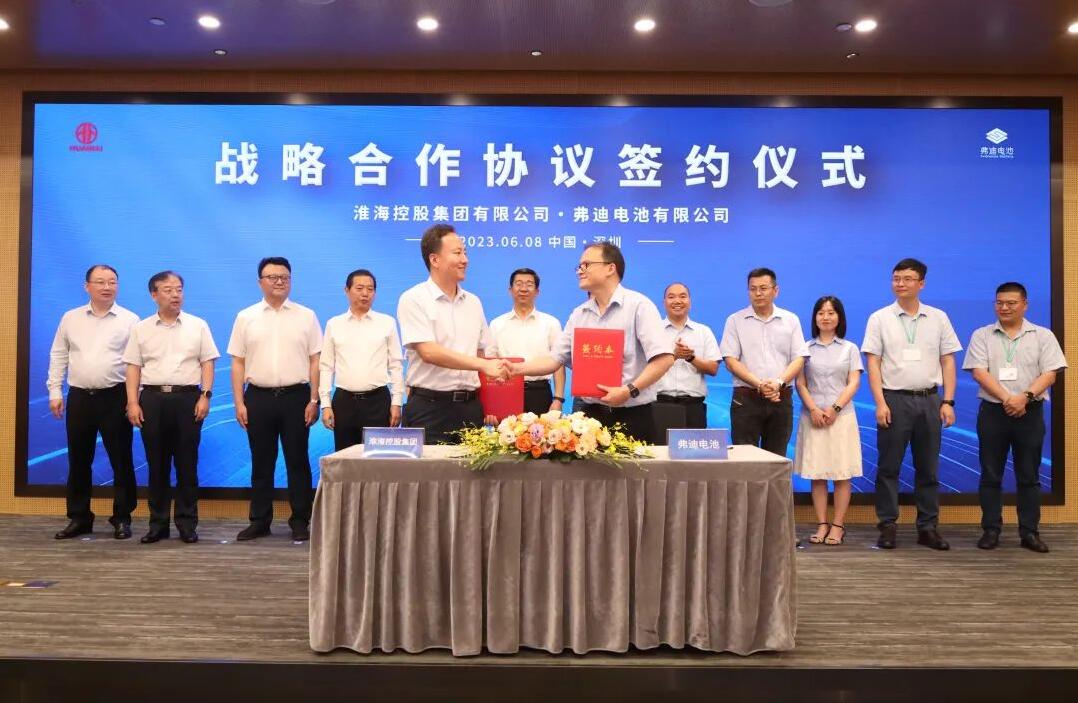
(Image credit: Huaihai Holding Group)

BYD (OTCMKTS: BYDDY) will set up a joint venture with a local conglomerate to build a sodium-ion battery production base, the first time we've seen it move forward in building capacity for this alternative to lithium batteries.

Huaihai Holding Group and BYD's battery unit FinDreams signed a strategic cooperation agreement at BYD's Shenzhen headquarters on June 8, according to a press release from Huaihai yesterday.

The two parties will establish a joint venture to build a sodium-ion battery production base in Xuzhou Economic and Technological Development Zone in Jiangsu province to jointly create the world's largest supplier of sodium battery systems for micro vehicles, according to the press release.

Huaihai will provide its resources including markets and application scenarios, and FinDreams will provide products and services, the release said.

Huaihai said it sees the tremendous economic and social value of sodium batteries and began its involvement in the industry years ago with a strategic investment in sodium-ion battery startup Natrium.

Huaihai and FinDreams will expand demand for mini-vehicle batteries nationwide and globally, centered on Xuzhou, it said.

Huaihai's press release provided no further details. The company was founded in 1976 and has operations in small vehicles, electric vehicles, parts and components, and financial services.

Since last November, there have been several rumors that BYD's sodium-ion battery would be in mass production in 2023 and that the first model to carry the battery would be the Seagull.

However, none of these rumors have been confirmed by BYD. BYD launched the Seagull on April 26 with a starting price of RMB 73,800 ($10,350), though no version with the sodium battery is yet available.

On February 23, battery maker Hina Battery unveiled three sodium-ion battery cell products and announced a partnership with Anhui Jianghuai Automobile Group Corp (JAC).

Hina Battery and Sehol -- a joint venture brand between JAC and Volkswagen Anhui -- jointly built a test vehicle with sodium-ion batteries based on the latter's Sehol E10X model.

On April 16, announced that its sodium-ion batteries will first be used in Chery's models. CATL unveiled its first-generation sodium-ion batteries on July 29, 2021, saying that the energy density of the cells alone has reached 160Wh/kg.

On April 20, local media 36kr reported that CATL's and BYD's sodium-ion batteries will both be installed in production vehicles this year, and they will both be a mix of sodium-ion and lithium-ion batteries.

Sodium-ion batteries currently have lower energy density than lithium-ion batteries, but cost less and sodium resources are seen as more abundant and readily available.

In the past two years, as lithium prices continue to rise sharply, sodium-ion batteries are highly anticipated.

However, since the beginning of this year, with the continued decline in lithium prices, sodium-ion batteries are seen as having a reduced cost advantage.

Sodium-ion's abundant resource reserves are difficult to quickly translate into cost advantages, and when the cost of lithium iron phosphate batteries is rapidly declining, automakers are hardly motivated to choose to carry sodium-ion batteries in the short term, the China Passenger Car Association (CPCA) said in a report on May 22.

($1 = RMB 7.1286)

CATL, BYD's sodium-ion batteries both to be in mass production within this year, report says

The post BYD to build sodium-ion battery production base in Xuzhou appeared first on CnEVPost.

For more articles, please visit CnEVPost.

Categories
Battery News China Electric eMobility eV Eve Energy Eve Energy Hungary Eve Energy Plant

Eve Energy to invest up to $1.4 billion in Hungary battery plant

Eve Energy will build a project for large cylindrical batteries for passenger cars in Hungary over a four-year construction period.

(Image credit: Eve Energy)

Chinese lithium battery maker Eve Energy plans to invest more than $1 billion in a battery plant in Hungary to expand its presence in overseas markets.

Eve Energy's board of directors has given its subsidiary EVE Power Hungary Kft the go-ahead to build a large cylindrical battery project for passenger cars in Hungary, with an investment amount not exceeding RMB 9.97 billion ($1.4 billion).

The project is located in Debrecen, Hungary, and the construction period is four years, according to an announcement yesterday by the Shenzhen-listed company.

The project will help improve the company's global industrial layout and promote the smooth progress of its overseas business, the announcement said.

It will also facilitate the company's rapid response to local demand for new energy vehicle (NEV) power batteries from key customers in Hungary and take on more orders from customers in Europe, Eve Energy said.

EVE Power Hungary signed an agreement on May 9 with Debreceni, a subsidiary of Hungary's Debrecen government, to purchase land owned by the latter in the city's northwest industrial zone for the production of cylindrical power batteries, according to a Shenzhen Stock Exchange announcement at the time.

The land has an area of 45 hectares and the purchase price is 22.5 euros per square meter plus VAT, for a total price of about 12.86 million euros, according to the announcement.

The deal will meet the company's need for production land for future growth and further scale up its production capacity for power and energy storage batteries, Eve Energy said.

Eve Energy's announcement provided no further information, though the move appears to be in preparation for supplying BMW.

On September 9, 2022, Eve Energy announced that it had finalized a battery supply relationship with BMW Group to supply large cylindrical lithium-ion cells for the latter's Neue Klasse line of models.

BMW also said at the time in a post on its official WeChat account that it had awarded contracts worth more than 10 billion euros to and Eve Energy to meet the demand for cells for the new generation of models.

The two partners will each build two battery plants in China and Europe, each with an annual capacity of 20 GWh, BMW said at the time, adding that it will also look for partners to build two more battery plants in the North American Free Trade Area.

Eve Energy is one of China's largest battery makers, with 1.33 GWh of batteries installed in May, ranking fourth with a 4.71 percent share, according to the China Automotive Battery Innovation Alliance (CABIA) earlier today.

($1 = RMB 7.1227)

China EV battery installations in May: BYD extends lead in LFP market

The post Eve Energy to invest up to $1.4 billion in Hungary battery plant appeared first on CnEVPost.

For more articles, please visit CnEVPost.
Categories
Battery Data Battery News BYD CABIA CALB CATL China Electric eMobility eV Gotion High-Tech LFP Batteries Monthly Data Ternary Batteries

China EV battery installations in May: BYD extends lead in LFP market

remains the largest power battery maker in China, but 's lead in the LFP market expanded in May.

After regaining the top spot in the lithium iron phosphate (LFP) market over CATL in April, BYD extended its lead in this segment in May.

In May, China's power battery installations were 28.2 GWh, up 52.1 percent year-on-year and up 12.3 percent from 25.1 GWh in April, according to data released today by the China Automotive Battery Innovation Alliance (CABIA).

CATL's power battery installed base in May was 11.67 GWh, ranking first with a 41.31 percent share, up from 40.83 percent in April.

BYD's power battery installed base in May was 8.68 GWh, ranking second with a 30.72 percent share, up 1.61 percentage points from 29.11 percent in April.

CALB ranked third with a 7.76 percent share of 2.19 GWh in May, down 0.98 percentage points from 8.74 percent in April.

Eve Energy ranked No. 4 in May with 1.33 GWh installed base and 4.71 percent share, down 0.77 percentage points from 5.48 percent in April.

Gotion High-tech ranked 5th in May with 1.01 GWh of installed base and a 3.58 percent share.

Gotion ranked fourth in March with 4.51 percent share, but was overtaken by Eve Energy in April.

China's ternary battery installed base in May was 9.0 GWh, accounting for 32.0 percent of total installed base, up 8.7 percent year-on-year and up 12.8 percent from April.

The installed base of LFP batteries was 19.2 GWh, accounting for 67.8 percent of the total installed base, up 87.2 percent year-on-year and up 11.8 percent from April.

In the LFP battery market, BYD installed 8.68 GWh in May, topping the list with a 45.30 percent share, up from 42.68 percent in April.

CATL's installed base in the LFP battery market in May was 5.90 GWh, ranking second with a 30.81 percent share, down from 33.65 percent in April.

In March, CATL's share of the LFP market was 39.47, higher than BYD's 38.88 percent, marking the first time it has overtaken BYD in this segment during the year.

BYD's share of the LFP market rebounded to 42.68 percent in April, regaining the lead over CATL's 33.65 percent.

Eve Energy and CALB ranked third and fourth in the LFP battery market with 6.33 percent and 6.14 percent shares, respectively.

In the ternary battery market, CATL ranked first with 63.87 percent of the installed base in May with 5.77 GWh.

CALB and LG Energy Solution ranked second and third in the ternary battery market with 11.26 percent and 7.48 percent shares, respectively.

China EV battery installations in May: 28.2 GWh

The post China EV battery installations in May: BYD extends lead in LFP market appeared first on CnEVPost.

For more articles, please visit CnEVPost.