Categories
CATL CATL US China Electric eMobility eV Tesla

Tesla seeks to build new battery plant with CATL in US, report says

As with Ford's deal structure, would own and operate the plant while licensing technology from , according to Bloomberg.  |  TSLA.US

(Image credit: CnEVPost)

Tesla is reportedly looking to build a new battery factory with CATL in the US, similar to the Chinese battery-maker giant's deal with Ford last month.

Bloomberg reported on the matter earlier today, saying Tesla discussed plans involving CATL with the US government.

Tesla representatives sought clarity on the Inflation Reduction Act rules that the US government is finalizing this week, and the company's senior director of global public policy Rohan Patel was among those involved in the discussions, according to the report.

Tesla hopes to build a plant wholly owned by it in partnership with CATL, similar to a deal Ford announced last month in Michigan, the report said.

Tesla is in expansion mode, deploying its $22 billion in cash to boost production and cut costs as it faces increasing competition, the report noted.

CATL produces lithium iron phosphate (LFP) batteries, a cheaper chemistry than the nickel-based batteries used in Western countries, and is key to the plan, the report said.

Tesla is considering building the battery plant in Texas to supply its electric vehicle assembly plant there, although the location has not been finalized, Bloomberg said, citing some people familiar with the matter.

As with Ford's deal structure, Tesla would own and operate the plant, while licensing technology from CATL, according to the report.

On February 13, Ford announced that it is investing $3.5 billion to build an LFP battery plant in Marshall, Michigan.

The plant, which is wholly owned by Ford, is the first battery plant to be wholly owned by a US automaker and will introduce LFP battery solutions for Ford's electric vehicle products.

The LFP battery plant is expected to start production in 2026 with an initial workforce of 2,500, Ford said last month.

The plant will have an initial design capacity of about 35 GWh per year and could supply power packs for about 400,000 Ford electric vehicles annually.

CATL is the world's largest maker of electric vehicle batteries, with a share far ahead of other peers.

CATL's installed battery volume in January-February was 25.5 GWh, up 34 percent from 19.0 GWh in the same period last year, according to data released yesterday by South Korean market research firm SNE Research.

The Chinese battery giant continues to rank No. 1 with a 33.9 percent share, the only global battery maker with a share of more than 30 percent.

Ford to build $3.5 billion LFP battery plant in Michigan with CATL's technology

The post Tesla seeks to build new battery plant with CATL in US, report says appeared first on CnEVPost.

For more articles, please visit CnEVPost.

Categories
CATL CATL US China Electric eMobility eV Tesla

Tesla seeks to build new battery plant with CATL in US, report says

As with Ford's deal structure, would own and operate the plant while licensing technology from , according to Bloomberg.  |  TSLA.US

(Image credit: CnEVPost)

Tesla is reportedly looking to build a new battery factory with CATL in the US, similar to the Chinese battery-maker giant's deal with Ford last month.

Bloomberg reported on the matter earlier today, saying Tesla discussed plans involving CATL with the US government.

Tesla representatives sought clarity on the Inflation Reduction Act rules that the US government is finalizing this week, and the company's senior director of global public policy Rohan Patel was among those involved in the discussions, according to the report.

Tesla hopes to build a plant wholly owned by it in partnership with CATL, similar to a deal Ford announced last month in Michigan, the report said.

Tesla is in expansion mode, deploying its $22 billion in cash to boost production and cut costs as it faces increasing competition, the report noted.

CATL produces lithium iron phosphate (LFP) batteries, a cheaper chemistry than the nickel-based batteries used in Western countries, and is key to the plan, the report said.

Tesla is considering building the battery plant in Texas to supply its electric vehicle assembly plant there, although the location has not been finalized, Bloomberg said, citing some people familiar with the matter.

As with Ford's deal structure, Tesla would own and operate the plant, while licensing technology from CATL, according to the report.

On February 13, Ford announced that it is investing $3.5 billion to build an LFP battery plant in Marshall, Michigan.

The plant, which is wholly owned by Ford, is the first battery plant to be wholly owned by a US automaker and will introduce LFP battery solutions for Ford's electric vehicle products.

The LFP battery plant is expected to start production in 2026 with an initial workforce of 2,500, Ford said last month.

The plant will have an initial design capacity of about 35 GWh per year and could supply power packs for about 400,000 Ford electric vehicles annually.

CATL is the world's largest maker of electric vehicle batteries, with a share far ahead of other peers.

CATL's installed battery volume in January-February was 25.5 GWh, up 34 percent from 19.0 GWh in the same period last year, according to data released yesterday by South Korean market research firm SNE Research.

The Chinese battery giant continues to rank No. 1 with a 33.9 percent share, the only global battery maker with a share of more than 30 percent.

Ford to build $3.5 billion LFP battery plant in Michigan with CATL's technology

The post Tesla seeks to build new battery plant with CATL in US, report says appeared first on CnEVPost.

For more articles, please visit CnEVPost.
Categories
CATL CATL US China Electric eMobility eV Tesla

Tesla seeks to build new battery plant with CATL in US, report says

As with Ford's deal structure, would own and operate the plant while licensing technology from , according to Bloomberg.  |  TSLA.US

(Image credit: CnEVPost)

Tesla is reportedly looking to build a new battery factory with CATL in the US, similar to the Chinese battery-maker giant's deal with Ford last month.

Bloomberg reported on the matter earlier today, saying Tesla discussed plans involving CATL with the US government.

Tesla representatives sought clarity on the Inflation Reduction Act rules that the US government is finalizing this week, and the company's senior director of global public policy Rohan Patel was among those involved in the discussions, according to the report.

Tesla hopes to build a plant wholly owned by it in partnership with CATL, similar to a deal Ford announced last month in Michigan, the report said.

Tesla is in expansion mode, deploying its $22 billion in cash to boost production and cut costs as it faces increasing competition, the report noted.

CATL produces lithium iron phosphate (LFP) batteries, a cheaper chemistry than the nickel-based batteries used in Western countries, and is key to the plan, the report said.

Tesla is considering building the battery plant in Texas to supply its electric vehicle assembly plant there, although the location has not been finalized, Bloomberg said, citing some people familiar with the matter.

As with Ford's deal structure, Tesla would own and operate the plant, while licensing technology from CATL, according to the report.

On February 13, Ford announced that it is investing $3.5 billion to build an LFP battery plant in Marshall, Michigan.

The plant, which is wholly owned by Ford, is the first battery plant to be wholly owned by a US automaker and will introduce LFP battery solutions for Ford's electric vehicle products.

The LFP battery plant is expected to start production in 2026 with an initial workforce of 2,500, Ford said last month.

The plant will have an initial design capacity of about 35 GWh per year and could supply power packs for about 400,000 Ford electric vehicles annually.

CATL is the world's largest maker of electric vehicle batteries, with a share far ahead of other peers.

CATL's installed battery volume in January-February was 25.5 GWh, up 34 percent from 19.0 GWh in the same period last year, according to data released yesterday by South Korean market research firm SNE Research.

The Chinese battery giant continues to rank No. 1 with a 33.9 percent share, the only global battery maker with a share of more than 30 percent.

Ford to build $3.5 billion LFP battery plant in Michigan with CATL's technology

The post Tesla seeks to build new battery plant with CATL in US, report says appeared first on CnEVPost.

For more articles, please visit CnEVPost.

Categories
Battery Data Battery News BYD CALB CATL China Electric eMobility eV Gotion High-Tech Monthly Data SNE Research Tesla

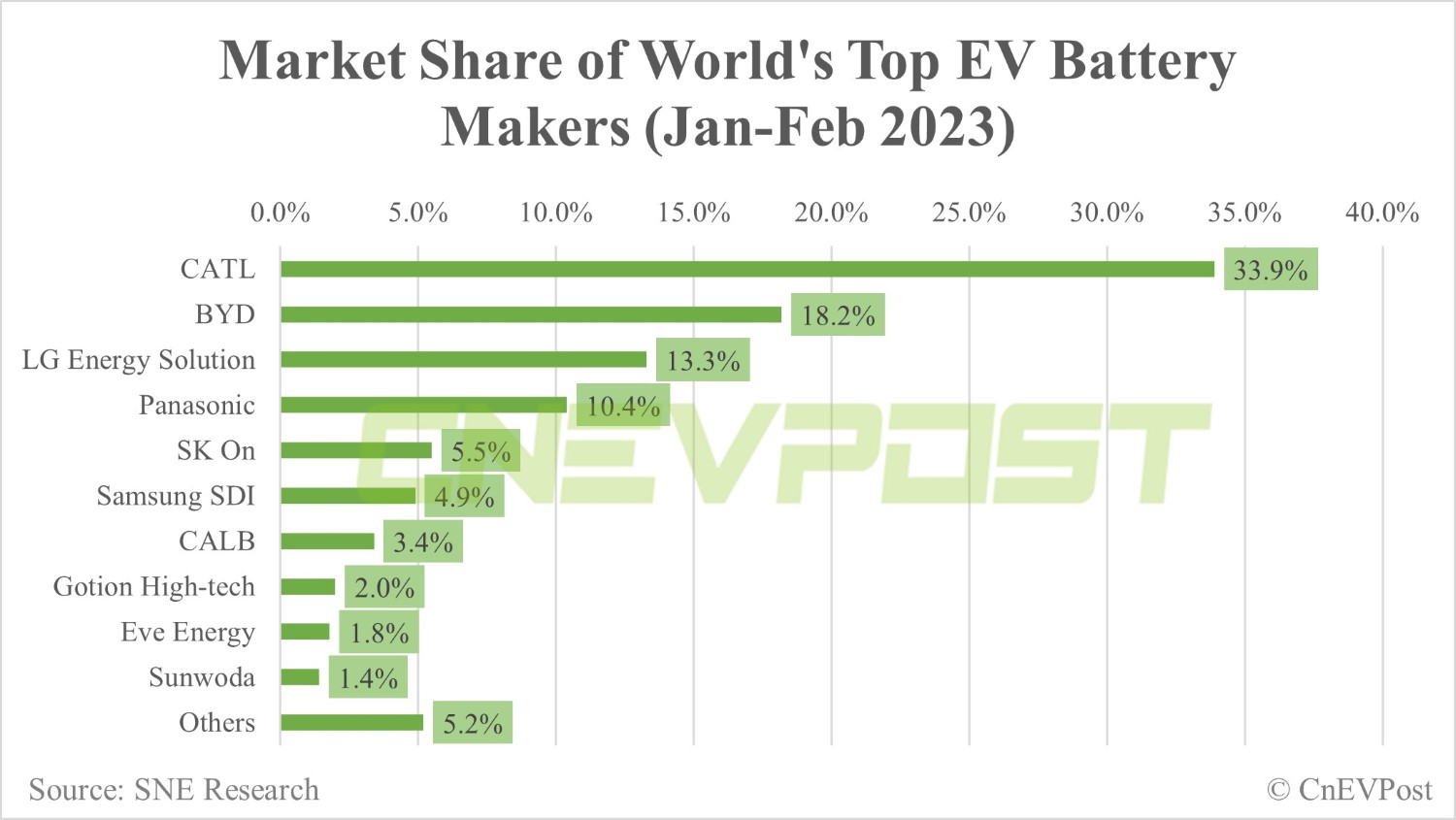
Global EV battery market share in Jan-Feb: CATL 33.9%, BYD 18.2%

's share in January-February was the same as in January, while saw its share rise.

CATL and BYD remained the top two players in the global EV battery market in the first two months, with the former's share remaining stable and the latter rising.

In January and February, the total battery consumption of EVs registered in each country was about 75.2 GWh, up 39.0 percent from the previous year, according to data released today by South Korean market research firm SNE Research.

CATL's battery installed base in January-February was 25.5 GWh, up 34 percent from 19.0 GWh in the same period last year.

The Chinese battery giant continues to rank first with a 33.9 percent share, the only global battery maker with a share of more than 30 percent.

CATL's share in January-February was the same as in January, but down 1.2 percentage points from 35.1 percent a year ago.

CATL's batteries are in high demand in passenger cars, including Model 3, Model Y, SAIC's Mulan, ET5 and the Chinese commercial vehicle market, and is expected to maintain its No. 1 position, SNE Research said.

BYD installed 13.7 GWh of power batteries in January-February, up 122.6 percent from 6.1 GWh in the same period last year.

The company ranked second with 18.2 percent market share in the first two months, up from 11.3 percent in the same period last year and up from 17.6 percent in January.

BYD is gaining traction in China's domestic market with its competitive pricing by establishing a vertically integrated supply chain management, including self-supply of batteries and vehicle manufacturing, SNE Research said.

LG Energy Solution saw a 51.9 percent year-on-year increase in power battery installed base of 10.0 GWh in January-February.

The South Korean company ranked third in the world with a 13.3 percent share, up from 12.2 percent a year earlier.

Japan's Panasonic ranked fourth with a 10.4 percent share, South Korea's SK On was fifth with 5.5 percent and Samsung SDI was sixth with 4.9 percent.

China's CALB, Gotion High-tech, Eve Energy and Sunwoda ranked seventh, eighth, ninth and tenth respectively, with shares of 3.4 percent, 2.0 percent, 1.8 percent and 1.4 percent respectively in January-February.

CATL's share in global EV battery market slips in Jan, BYD rises

The post Global EV battery market share in Jan-Feb: CATL 33.9%, BYD 18.2% appeared first on CnEVPost.

For more articles, please visit CnEVPost.

Categories
CATL China Deals Electric eMobility eV

CATL reaches deal to supply energy storage systems to US firm HGP

The 450-MWh battery storage project will be deployed in Texas and is expected to begin commercial operations in 2024.

(Image credit: )

CATL recently entered into a 450 MWh supply agreement with US battery storage project developer HGP, the battery giant's latest similar agreement with a US company.

The battery storage project will be deployed in Texas and is expected to begin commercial operations in 2024, a CATL press release said yesterday.

CATL will provide HGP with the EnerC, an outdoor premade pod system that offers high safety, long life, and high integration for a variety of weather extremes, according to the release.

The partnership leverages CATL's strengths in battery technology and HGP's strengths in energy infrastructure and storage resource development and will provide a more convenient solution for the market, the release said.

This helps meet the growing demand for clean energy in Texas and North America and highlights CATL's and HGP's commitment to achieving sustainable development, the Chinese battery giant said.

The two companies will also establish a long-term partnership to drive the implementation of utility-scale and distributed energy storage projects up to 5 GWh in size, according to the release.

HGP is based in Dallas, Texas, and has decades of market experience deploying grid investment-grade energy storage assets.

This is CATL's latest agreement with a US company for the supply of energy storage systems.

Last September, CATL announced that it had entered into a partnership agreement with FlexGen, a US provider of energy storage technology platforms and solutions, to supply the latter with 10 GWh of energy storage products over a three-year period.

CATL will supply FlexGen with EnerC, a containerized liquid-cooled energy storage product that can withstand a wide range of weather extremes and keep the system running safely and reliably for 20 years, the power battery giant previously said.

In October 2022, CATL entered into an agreement with Primergy Solar LLC, a US utility and distributed PV and energy storage operator, to exclusively supply batteries for the latter's Gemini PV and energy storage project.

Located near Las Vegas, Nevada, the project will have 690 MWac/966 MWdc solar panels and a 1.416 GWh energy storage system and will be one of the largest PV storage projects in the US when completed, CATL said at the time.

CATL has begun mass production of Qilin Battery, report says

The post CATL reaches deal to supply energy storage systems to US firm HGP appeared first on CnEVPost.

For more articles, please visit CnEVPost.

Categories
avatr 11 Car Launch CATL China Electric Electric cars eMobility eV Huawei

Avatr 11 single-motor version from Changan, Huawei, and CATL launched in China

The new car has a starting price of $46,560 and will be available in Huawei stores from April 1.

The post Avatr 11 single-motor version from Changan, Huawei, and CATL launched in China appeared first on CarNewsChina.com.

Categories
BYD CATL China Electric Electric cars eMobility eV HiPhi HiPhi Y Human Horizons Kia-Yueda Report

HiPhi Y SUV with 810 km of range confirmed. New spy shots

The HiPhi Y exposed with a massive 115-kWh battery and up to 810 km of pure-electric range. It is ready to rival Nio, XPeng and others.

The post HiPhi Y SUV with 810 km of range confirmed. New spy shots appeared first on CarNewsChina.com.

Categories
CATL China Electric eMobility eV Li Auto Lithium Lithium Carbonate Lithium Prices Nio Zeekr

CATL to reach new price agreement with automakers as soon as end of Mar, report says

The price of lithium, a raw material for batteries, has accelerated its decline, with industrial-grade lithium carbonate falling RMB 7,500 per ton to RMB 302,500 per ton today.

New price agreements between Chinese power battery giant and some local automakers are expected to be reached this month, at a time when battery raw material prices continue to fall.

CATL's lithium rebate policy is progressing steadily, and it is now at the practical stage of signing agreements with some car companies, local media Cailian said today, citing sources close to the battery maker.

These agreements are expected to be reached by the end of this month at the earliest, the source said.

CATL's plan was first reported on February 17 by local media outlet 36kr, which said it is not aimed at all customers, but rather at several strategic customers, including (NYSE: NIO), (NASDAQ: LI), and .

The core terms of the partnership include that CATL will settle a portion of the price of power battery supply with car companies at a rate of RMB 200,000 ($28,970) per ton of lithium carbonate for the next three years.

At the same time, car companies signing the partnership will be required to commit about 80 percent of their battery purchases to CATL, according to the report.

CATL management first acknowledged the move during the company's earnings call on March 9.

CATL's lithium sharing plan is not for the purpose of lowering prices, but rather the company already has some mineral resources and does not want to reap windfall profits, its management said.

CATL wants to be able to share with long-term strategic customers and is moving forward with communications to that end, the company said.

Prior to that, Li Auto and NIO both said that they had ongoing discussions with CATL when asked about the topic in their respective earnings calls.

CATL's move comes as lithium carbonate has been falling for months.

Today's quotes for industrial-grade lithium carbonate and battery-grade lithium carbonate in China were both down RMB 7,500 per ton, with the latest average prices at RMB302,500 per ton and RMB 340,000 per ton, respectively, according to My Steel.

($1 = RMB 6.9040)

CATL confirms it's negotiating new prices with EV makers

The post CATL to reach new price agreement with automakers as soon as end of Mar, report says appeared first on CnEVPost.

For more articles, please visit CnEVPost.

Categories
BAIC CATL China Deals Electric eMobility eV

CATL, BAIC sign deal to jointly develop battery products

will participate in the vehicle development and production of BAIC-affiliated NEV companies, and provide power battery products and services.

(Image credit: CATL)

BAIC Group, which has lagged behind many of its local counterparts in the transition to electrification, appears to be stepping up its efforts.

CATL and BAIC signed a strategic cooperation agreement on March 13, in which they plan to jointly develop power battery products and tap into the new energy vehicle (NEV) market, according to a press release from the power battery giant yesterday.

CATL will participate in the vehicle development and production of BAIC-affiliated NEV companies and provide power battery products and services, according to the press release.

The two sides will build a close strategic partnership and cooperate fully in power batteries, the release said.

BAIC's efforts in the NEV market are mainly carried out by its subsidiary Beijing Electric Vehicle Co Ltd (BJEV), but its performance has been lukewarm.

BJEV sold 50,179 units for the full year 2022, up 92.06 percent from 26,127 units in 2021, but lags behind most Chinese electric vehicle startups, according to data released by its parent company BAIC BluePark New Energy Technology Co.

In the first two months of this year, BJEV sales were 4,812 units, up 42.16 percent from 3,385 units in the same period last year.

In August 2022, Bloomberg reported that smartphone giant Xiaomi was in talks with BAIC Group to collaborate on the production of electric vehicles, which could see vehicles built by BAIC BluePark and co-branded with .

BAIC Group later told local media that the company had "not heard of this."

That comes after BAIC BluePark announced on July 15 that it plans to raise up to 8 billion yuan ($1.16 billion) in additional shares to no more than 35 specific targets.

The stock offering is intended to increase the company's capital strength, as it continues to increase the size of its business and invest in product development amid the rapid growth of China's NEV industry, BAIC BluePark said at the time.

BAIC BluePark's share price has been weak over the past year and is currently down about 40 percent from its high last June.

($1 = RMB 6.8715)

Xiaomi reportedly in talks with BAIC to jointly build EVs

The post CATL, BAIC sign deal to jointly develop battery products appeared first on CnEVPost.

For more articles, please visit CnEVPost.

Categories
BAIC CATL China Deals Electric eMobility eV

CATL, BAIC sign deal to jointly develop battery products

will participate in the vehicle development and production of BAIC-affiliated NEV companies, and provide power battery products and services.

(Image credit: CATL)

BAIC Group, which has lagged behind many of its local counterparts in the transition to electrification, appears to be stepping up its efforts.

CATL and BAIC signed a strategic cooperation agreement on March 13, in which they plan to jointly develop power battery products and tap into the new energy vehicle (NEV) market, according to a press release from the power battery giant yesterday.

CATL will participate in the vehicle development and production of BAIC-affiliated NEV companies and provide power battery products and services, according to the press release.

The two sides will build a close strategic partnership and cooperate fully in power batteries, the release said.

BAIC's efforts in the NEV market are mainly carried out by its subsidiary Beijing Electric Vehicle Co Ltd (BJEV), but its performance has been lukewarm.

BJEV sold 50,179 units for the full year 2022, up 92.06 percent from 26,127 units in 2021, but lags behind most Chinese electric vehicle startups, according to data released by its parent company BAIC BluePark New Energy Technology Co.

In the first two months of this year, BJEV sales were 4,812 units, up 42.16 percent from 3,385 units in the same period last year.

In August 2022, Bloomberg reported that smartphone giant Xiaomi was in talks with BAIC Group to collaborate on the production of electric vehicles, which could see vehicles built by BAIC BluePark and co-branded with .

BAIC Group later told local media that the company had "not heard of this."

That comes after BAIC BluePark announced on July 15 that it plans to raise up to 8 billion yuan ($1.16 billion) in additional shares to no more than 35 specific targets.

The stock offering is intended to increase the company's capital strength, as it continues to increase the size of its business and invest in product development amid the rapid growth of China's NEV industry, BAIC BluePark said at the time.

BAIC BluePark's share price has been weak over the past year and is currently down about 40 percent from its high last June.

($1 = RMB 6.8715)

Xiaomi reportedly in talks with BAIC to jointly build EVs

The post CATL, BAIC sign deal to jointly develop battery products appeared first on CnEVPost.

For more articles, please visit CnEVPost.